
Understanding the Difference Between Organic Fertilizer and True Bio-Organic Fertilizer
Why Biology Matters More Than Organic Matter
The terms Organic Fertilizer and Bio-Organic Fertilizer are often used interchangeably in the agricultural industry.
However, they are not the same thing.
This misunderstanding exists across many sectors of agriculture, including among farmers, distributors, consultants, researchers and even regulatory agencies.
Understanding the difference is important because it directly affects soil health, crop productivity and long-term sustainability.
What Is Organic Fertilizer?
Organic fertilizer refers to materials derived from natural biological sources.
Examples include:
- Compost
- Animal manure
- Poultry litter
- Plant residues
- Agricultural by-products
- Organic waste-derived fertilizers
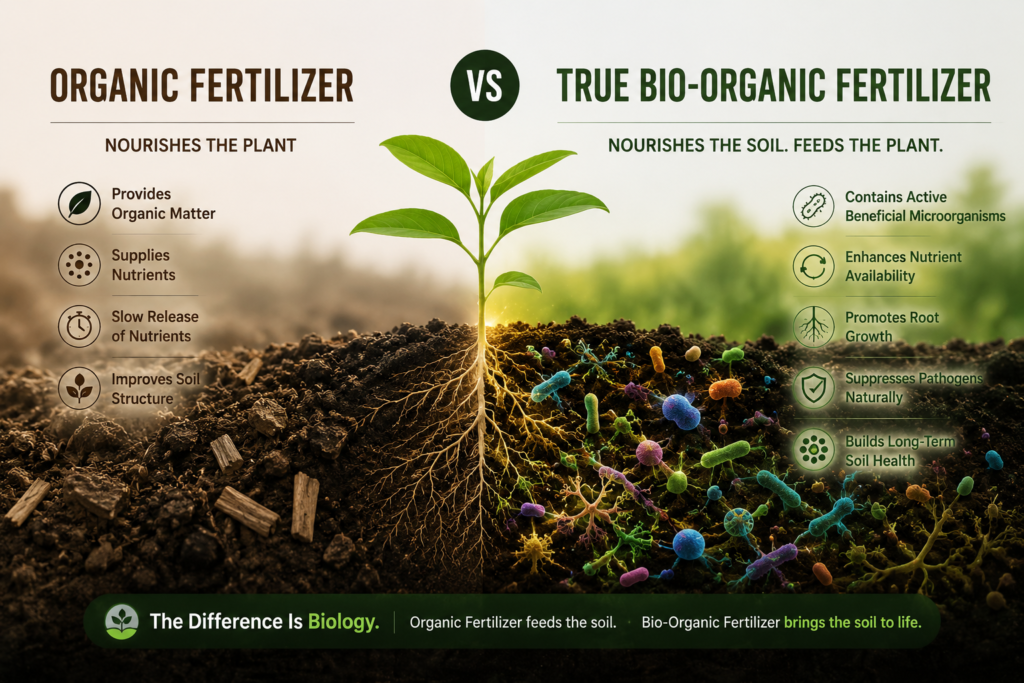
The primary function of organic fertilizer is to supply organic matter and nutrients to the soil.
Organic fertilizers can improve soil structure, increase water-holding capacity and provide a slow-release source of nutrients.
However, organic fertilizer alone does not necessarily contain a significant population of active beneficial microorganisms.
In many cases, the biological activity within the product is minimal or inconsistent.
What Is a True Bio-Organic Fertilizer?
The key difference lies in the word:
“Bio”
Bio means life.
A true bio-organic fertilizer contains active and beneficial living microorganisms that continue to perform biological functions after application.
These microorganisms actively interact with the soil ecosystem and contribute to nutrient cycling, organic matter decomposition and overall soil health.
Without active biological activity, a product remains an organic fertilizer, regardless of how much organic matter it contains.
Simply put:
Organic Fertilizer = Organic Matter
Bio-Organic Fertilizer = Organic Matter + Active Beneficial Microbiology
Why Microorganisms Are So Important
Healthy soil is not just a mixture of sand, clay and organic matter.
Healthy soil is a living ecosystem.
A single gram of healthy soil may contain billions of microorganisms performing countless biological processes.
These microorganisms help to:
- Break down organic matter
- Release nutrients into plant-available forms
- Fix atmospheric nitrogen
- Solubilize phosphorus
- Produce beneficial enzymes
- Improve soil structure
- Enhance root development
- Suppress harmful pathogens
- Support plant immunity
Without these biological processes, much of the nutrient value within organic matter remains unavailable to plants.
Microorganisms act as the workforce of the soil ecosystem.
Why One Microbe Is Not Enough
Many bio-organic fertilizer products promote the presence of one or two beneficial microbial species.
While these microorganisms may provide certain benefits, nature does not function through isolated organisms.
A useful way to understand this is to imagine a city.
A successful city cannot consist only of doctors.
It also requires engineers, builders, teachers, farmers, scientists, transport operators and many other professions.
Each contributes a unique role that supports the entire community.
Soil biology functions in the same way.
Different microorganisms perform different tasks.
Some decompose organic matter.
Some release nutrients.
Some suppress pathogens.
Some stimulate root growth.
Some improve soil structure.
No single microorganism can effectively perform all these functions.
The most productive soils are supported by diverse and balanced microbial communities working together.
The Living Soil Concept
Modern agriculture often focuses on feeding plants directly.
However, long-term soil productivity depends on feeding the biological ecosystem that supports the plants.
When beneficial microorganisms thrive:
- Organic matter decomposes more efficiently
- Nutrient availability increases
- Soil structure improves
- Water retention increases
- Plant resilience improves
- Soil fertility becomes more sustainable
The goal is not simply to fertilize crops.
The goal is to cultivate a living soil ecosystem.
Healthy Soil, Healthy Food, Healthy Life
Everything begins with the soil.
Healthy Soil
→ Healthy Plants
→ Healthy Livestock
→ Healthy People
As soil biology improves, crops gain access to a more balanced nutrient profile and a healthier growing environment.
The benefits extend throughout the food production chain.
This is why many scientists and agricultural professionals increasingly recognize soil microbiology as one of the most important foundations of sustainable agriculture.
Looking Beyond Nutrients
The future of agriculture is no longer only about supplying nutrients.
It is about restoring biological function.
When evaluating any bio-organic fertilizer, an important question should be asked:
Does this product simply contain organic matter, or does it contain a living microbial ecosystem capable of continuously improving soil health?
Understanding this difference may be one of the most important steps toward building more productive, resilient and sustainable agricultural systems for the future.
About OMSA Biosystems™
At OMSA Biosystems™, we believe that biology is the foundation of sustainable agriculture.
Our approach focuses on cultivating diverse, active microbial ecosystems that work together to support soil regeneration, nutrient cycling and environmental sustainability.
Through our Microbiome Intelligence™ platform, we are committed to transforming organic resources into living biological solutions that help rebuild healthy and productive ecosystems.